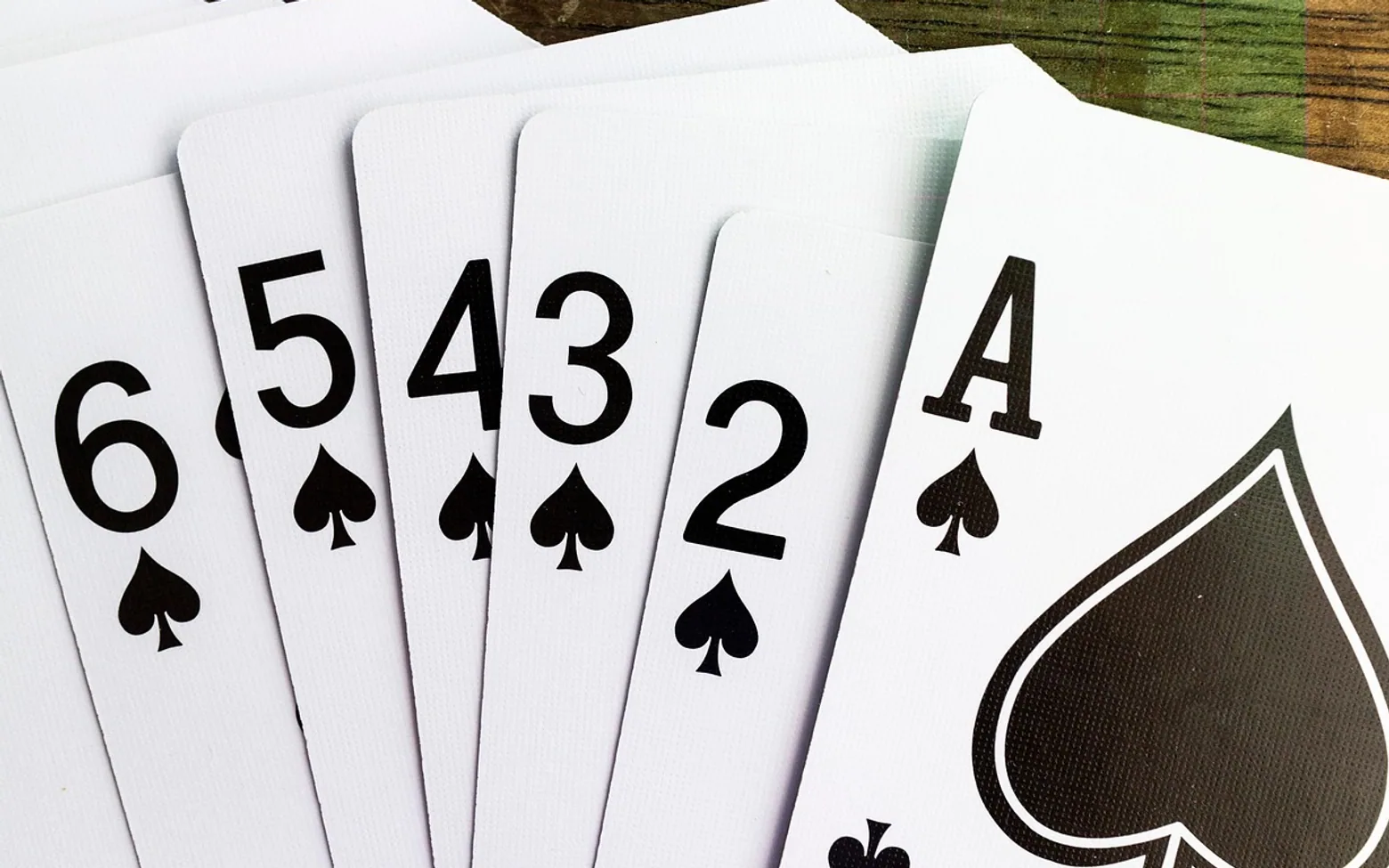
Walk past a group of friends playing cards at a coffee shop in Jakarta, Penang or Singapore and there is a fair chance the game on the table is Capsa Susun. The name roughly means "stacked" or "arranged" capsa, and that describes the heart of it: every player receives thirteen cards and has to arrange them into three separate poker hands. It is close kin to the game many Western players know as Chinese poker, and in the Philippines a similar game is called Pusoy. Rules shift from table to table, so treat what follows as the common core.
Players, deck and deal
Capsa Susun uses a standard 52-card deck with no jokers. It works best with four players, because four hands of thirteen use the whole deck. With fewer players the extra cards are simply set aside. The dealer shuffles and deals all thirteen cards to each seat, and from that moment there is no drawing, swapping or discarding. Everything depends on how you sort what you were given.
The three hands
Each player splits their thirteen cards into three rows:
| Row | Cards | Best possible hand |
|---|---|---|
| Front (top) | 3 | Three of a kind |
| Middle | 5 | Straight flush |
| Back (bottom) | 5 | Straight flush |
The five-card rows use the familiar poker ranking: straight flush, four of a kind, full house, flush, straight, three of a kind, two pair, one pair, high card. The three-card front can only hold three of a kind, a pair or high card, because straights and flushes do not count in a three-card row under most house rules.
The one rule you cannot break
The back hand must be at least as strong as the middle, and the middle must be at least as strong as the front. A player who sets a stronger hand above a weaker one has made a foul, sometimes called a mis-set. A fouled arrangement usually loses every row automatically, so most experienced players check their order twice before revealing.
Setting your cards
Once the cards are dealt, everyone arranges their rows face down. There is often a time limit, set by agreement or by the app. When all players are ready, the hands are turned over together.
The art lies in balance. Putting all your strength in the back row can win that row comfortably while leaving the middle and front with almost nothing. Spreading strength more evenly can win two rows out of three. A few habits help newcomers:
- Start by finding your strongest five-card hand and place it at the back.
- Look for a second solid five-card hand for the middle before worrying about the front.
- Keep a high pair or high cards for the front if you can, since rivals' fronts are often weak.
- Recheck the order before you lock in. A strong but fouled hand is worth less than a modest legal one.
Scoring against each rival
After the reveal, every player compares their three rows with every other player's, row by row. The common method gives one point for each row you win against a particular opponent and takes one point for each row you lose. Win all three rows against the same rival and many tables award a bonus, often called a sweep or scoop, which doubles the points for that match-up.
Some groups also give extra points when a strong hand appears in a particular row, for example a full house in the middle or three of a kind in the front. These bonuses are pure house rules, so agree on them before the first deal.
Special hands
Many tables recognise a handful of special thirteen-card combinations that win immediately without the usual comparison. Examples you may meet include a dragon (one card of every rank from two to ace), six pairs, or three flushes across the three rows. Which combinations count, and what they pay in points, varies widely. Write the list down if your group uses them, because arguments tend to start precisely when someone thinks they hold one.
Playing on a phone
Capsa Susun moved onto mobile screens years ago, alongside other games popular in the region that we touch on in our piece about Malaysian casino games on a smartphone. Apps sort cards with a tap and warn you about fouls, which makes them a friendly place to learn the arrangement logic for free or for points.
If any stakes are involved, the game is for adults aged 18 and over, the amounts should be small and agreed in advance, and it must be legal where you are playing. Playing for points teaches exactly the same skills.
Before you deal
- Agree on the number of players and what happens to leftover cards.
- Confirm how fouls are punished.
- Settle the sweep bonus and any row bonuses.
- List the special hands your table accepts.
- Decide on a time limit for setting cards and a finishing score.
With those five points settled, the rest of the evening is about the satisfying puzzle of thirteen cards and three rows. You can find more table games in our Card Tables section.
Don’t miss these
 Online GamblingThe Factors Driving the Popularity of Online Football Betting Platforms in Vietnam2 min
 Money HabitsNeeds vs Wants: Sorting Spending Into Two Honest Piles4 min
 Card TablesBlackjack Insurance: Why the Side Bet Rarely Adds Up4 min
 Card TablesLet It Ride Poker: Three Bets, Two Chances to Pull Back4 min