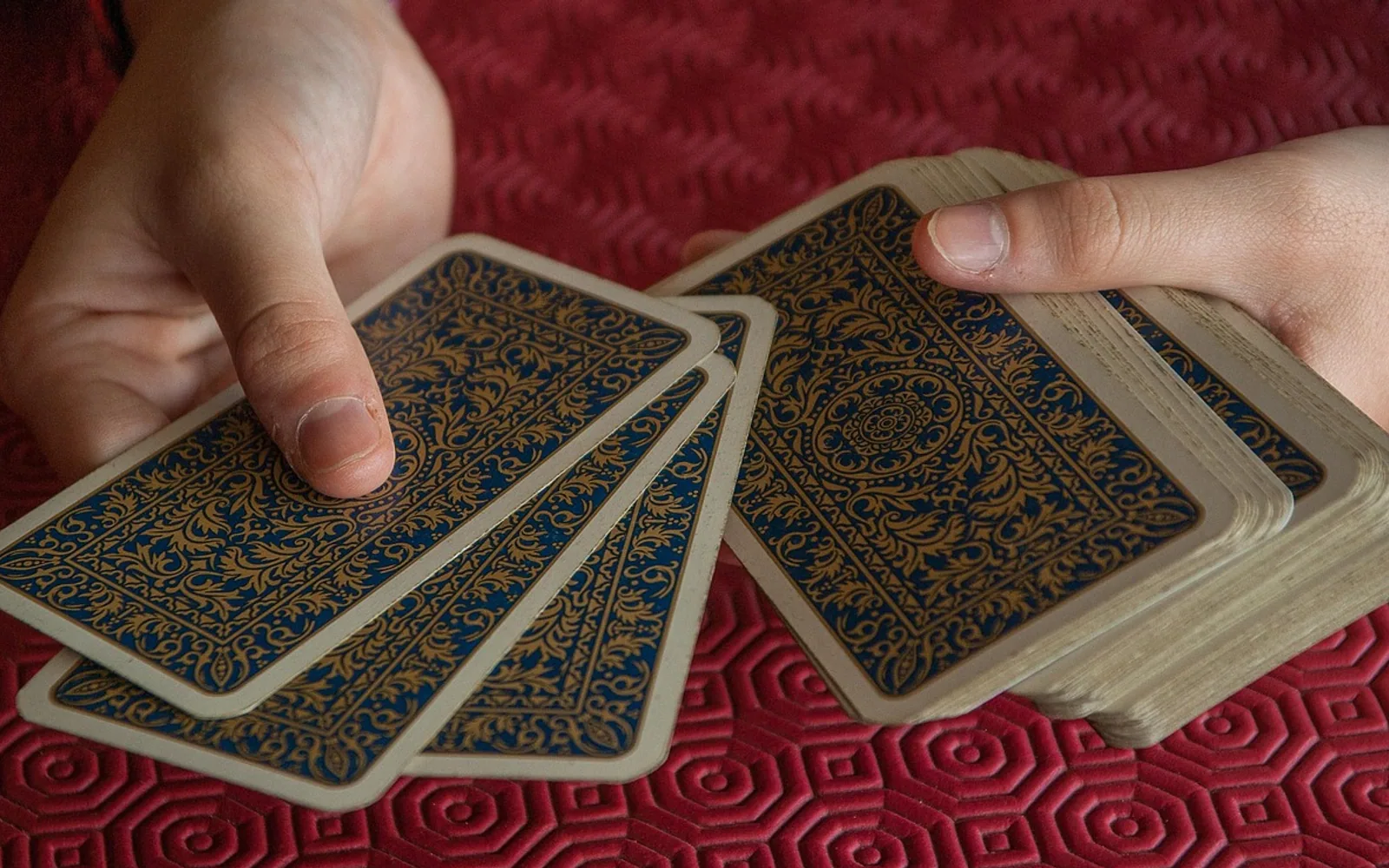
Go-Stop is a matching game played with hwatu, a deck of 48 small, stiff cards illustrated with flowers, plants and animals for each month of the year. Players match cards from their hand with cards on the table, collect sets that score points, and whoever reaches the target first faces the decision that names the game: call "go" and keep playing for more, or call "stop" and take the win. It is quick to learn, easy to play with three people, and a fixture at Korean family gatherings.
Where the cards come from
The flower cards reached Korea from Japan, where a similar deck is known as hanafuda, and became widely played during the twentieth century. Over time Korean players developed their own scoring and their own game, and today the red-backed hwatu deck is instantly recognisable in Korea. Packs are sold cheaply, and many households keep one in a drawer next to a padded blanket used as a playing surface, since the thick cards are slapped down hard when a match is made.
The 48-card deck
The deck is split into twelve suits of four cards, one suit per month. Each month has its own plant or symbol: pine for January, plum blossom for February, cherry blossom for March, and so on through to paulownia in December. Within each month the four cards are not equal. Every card belongs to one of four types, and those types decide what it is worth.
| Card type | Korean name | What to look for | Role in scoring |
|---|---|---|---|
| Brights | gwang | Cards marked with a small character in a circle; only five in the deck | The most valuable sets, built from three or more |
| Animals | yeol / kkeut | Birds, deer, boar and other creatures | Score once you hold several; some special trios add more |
| Ribbons | tti / dan | A coloured strip of paper across the plant | Score in quantity; red, blue and plain ribbon sets carry bonuses |
| Junk | pi | Plain cards with only the plant | Low value each, but a large pile adds up |
Some decks also include a few bonus cards that count as extra junk. Whether they are used is one of many house decisions.
How a round of Go-Stop flows
The standard game is for three players, though two-player versions exist. After shuffling, the dealer gives each player a hand, lays several cards face up in the middle and leaves the rest as a face-down draw pile. Play then moves around the table.
- Play a card from your hand. If it shows the same month as a card on the table, it captures that card. If not, it stays on the table.
- Flip the top card of the draw pile. It can also capture a matching card on the table, or it simply joins the layout.
- Collect your captures. Captured cards go face up in front of you, sorted by type so everyone can see your progress.
- Check your score. Once your captured sets reach the agreed minimum, often a small handful of points, you must decide whether to go or stop.
There are special situations too. When three cards of one month end up stacked together, the player who later captures all of them may take a junk card from each opponent. Matching a card that someone just failed to use, or clearing the whole table, often brings similar rewards. These small swaps keep everyone involved even when one player is ahead.
Go or stop?
The heart of the game is the choice that comes with every new scoring point. Stopping ends the hand and pays out your current score. Going means play continues, and if you score again your total grows, with each successive "go" usually increasing the payout further. The catch: if an opponent reaches a score before you add to yours, the gamble backfires, and in many house rules the player who went is penalised heavily for it.
That tension is why Go-Stop is talked about as much as it is played. A cautious player stops early and collects small wins; a bold one keeps going and either gets a big hand or hands the round to someone else. Reading what your opponents have captured, and which months are still out, is the real skill.
Are the rules the same everywhere?
No. Scoring minimums, bonus cards, penalties for a failed go and the value of certain sets all vary between regions and even between families. The safest approach at a new table is to ask how the house plays before the first deal, the same advice that applies to other regional games such as Pusoy Dos in the Philippines.
A holiday game
Go-Stop is closely tied to Seollal, the Lunar New Year, and Chuseok, the autumn harvest festival, when relatives gather for several days and the deck comes out after the meal. Many families play for points kept on paper, or for tiny coins and snacks, mainly for the noise and conversation. Like other games built around a shared table, from Capsa Susun's thirteen-card hands to a round of rummy, it gives grandparents and teenagers something to do together.
A short note on stakes: the game is meant to be fun. If money changes hands, keep it to adults, keep amounts trivial, and check what the law allows where you live, since gambling rules differ widely between countries.
Why it feels like a night of karaoke
In Korean social life, Go-Stop shares a lot with another group pastime: the noraebang, or karaoke room. Both are played among people who already know each other, both reward a bit of showmanship, and neither depends on being especially good at it. Friends who have spent an evening around the hwatu blanket often finish by booking a private karaoke room for an hour of singing. Visitors curious about that side of an evening out in Seoul can read up on Gangnam Karaoke in Seoul for an idea of how private rooms there are usually arranged.
Getting started
- Learn the twelve months first; matching becomes quick once the plants are familiar.
- Sort your captures by type as you go so the score is easy to check.
- Agree on the minimum score and the penalty for a failed go before dealing.
- Start with points on paper until the scoring feels natural.
A few rounds are usually enough to see why the deck has lasted: the cards are pretty, the rules fit on one page, and the final call between going and stopping makes every hand a small piece of theatre.
Don’t miss these
 Online GamblingThe Factors Driving the Popularity of Online Football Betting Platforms in Vietnam2 min
 Money HabitsNeeds vs Wants: Sorting Spending Into Two Honest Piles4 min
 Card TablesBlackjack Insurance: Why the Side Bet Rarely Adds Up4 min
 Card TablesLet It Ride Poker: Three Bets, Two Chances to Pull Back4 min