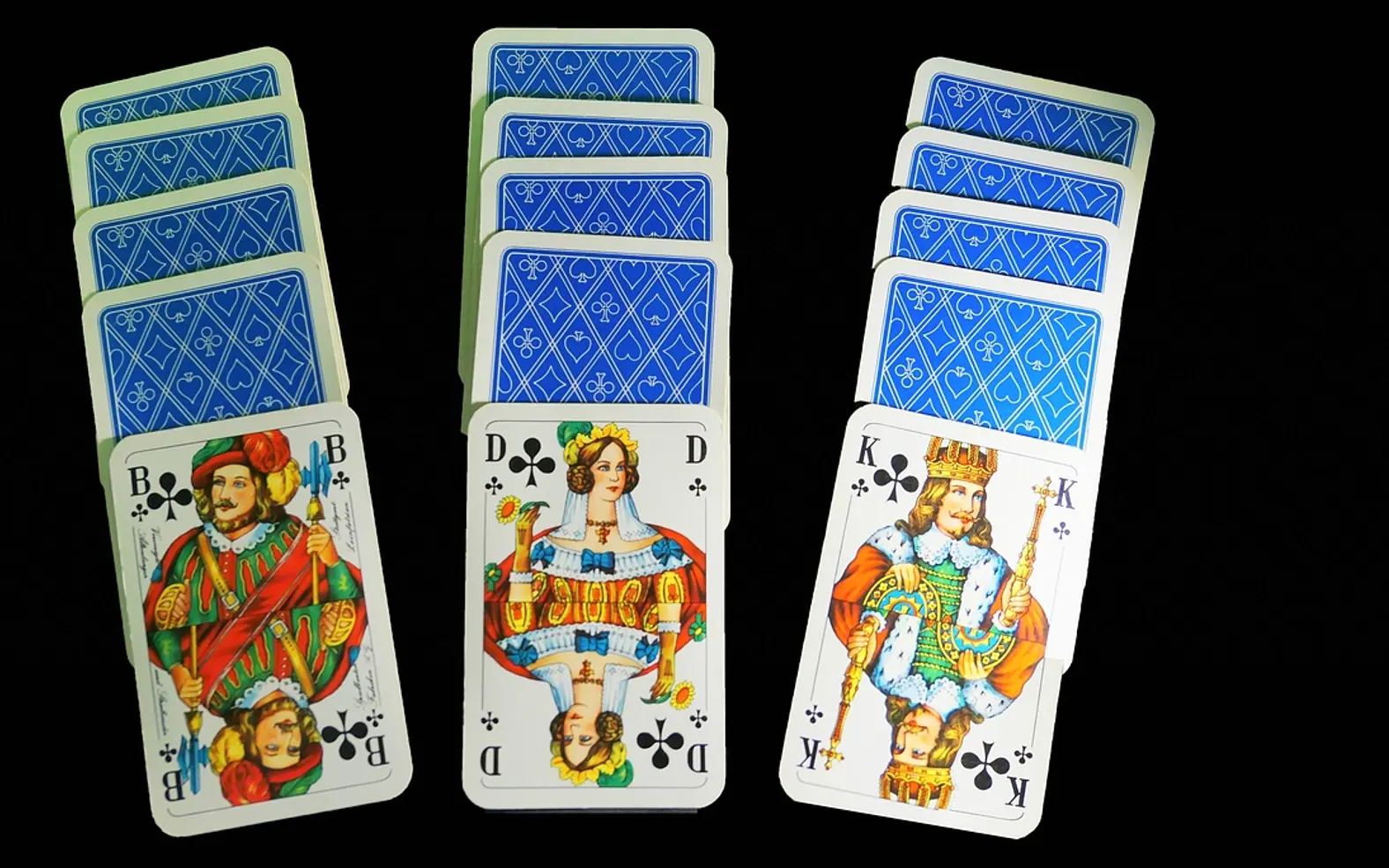
The stock pile is down to its last few cards, two players have melds face up in front of them, and the third is still holding everything close. Somebody taps the table and says "Draw". That moment, where a hand can be settled on points instead of played to the end, is what gives Tongits its particular tension, and it is why the game turns up at birthday tables and in phone apps all over the Philippines.
At heart, Tongits is a rummy game for three people. You draw, you discard, and you try to turn your cards into sets and runs before anyone else does. The twist is that you can also add cards to melds your opponents have already laid down, and that a player who has exposed something may stop the hand early and challenge the others to compare what they still hold.
Players, deck and the deal
Tongits uses one standard 52-card deck with no jokers and is played by exactly three people. The dealer gives themselves thirteen cards and each of the other two players twelve. The remaining cards go face down in the middle as the stock, and the discard pile starts empty.
Because the dealer already holds the extra card, they do not draw on their first turn. They begin by laying down any melds they want and then discarding, and play moves on from there. Many groups pass the deal to the winner of the previous hand, while others rotate it; agree on which before you start.
Melds: sets and runs
Only two kinds of combination count:
- Set: three or four cards of the same rank, such as three sevens or four queens.
- Run: three or more cards in sequence in the same suit, such as the 4, 5 and 6 of hearts.
The ace is low. A-2-3 of one suit is a run, but Q-K-A is not, and a run cannot wrap from king to ace to two. Mixed suits never form a run, however neat the numbers look.
Card values
Points matter whenever a hand ends without someone emptying their hand, because the player holding the smallest total of unmelded cards wins. The usual values are:
| Card | Points |
|---|---|
| Ace | 1 |
| 2 to 10 | Face value |
| Jack, Queen, King | 10 each |
That scale shapes play. A loose king costs ten points if the hand stops suddenly, while a stray ace costs one, so high unmatched cards are the first ones most players try to shed.
A turn, step by step
- Draw one card. Take the top card of the stock, or take the top card of the discard pile. You may only take a discard if you can use it straight away in a meld with cards from your hand, and that meld has to go face up on the table at once.
- Expose melds if you wish. Lay any sets or runs you hold face up in front of you. Nothing forces you to do this yet, but exposed melds matter later when someone calls Draw.
- Lay off cards. Add single cards to any meld already on the table, your own or an opponent's. A fourth eight on someone's set of eights, or the 9 of spades on their 6-7-8 of spades, both count. Filipino players call this sapaw.
- Discard one card face up on the discard pile. Your turn ends there.
Laying off is more than a way to get rid of cards. Adding to an opponent's meld can block their plans for that hand, as the rules on calling Draw below make clear.
Three ways a hand can end
Tongits
A player who melds or lays off every card in their hand, with or without a final discard depending on the table, calls "Tongits" and wins outright. It is the cleanest finish and usually earns a bonus under the group's scoring.
The stock runs out
If the last stock card is drawn and nobody has gone out, all three players reveal their remaining cards. The lowest point total wins. At most tables a player who has not exposed a single meld during the hand cannot win this way; they are said to be "burned".
Calling Draw
At the start of a turn, before drawing, a player with at least one exposed meld may call Draw instead of playing on. Each opponent then chooses whether to fold or to fight by showing their hand, and only players with an exposed meld can fight. The lowest total among the caller and anyone who fights wins the hand.
A common restriction stops the trick from being too easy: if another player laid off on one of your melds since your last turn, you cannot call Draw on this turn. That is why sapaw is used defensively near the end of a hand.
House rules worth settling first
Tongits travels by word of mouth, so details shift from barangay to barangay and from one app to the next. Before the first deal, check:
- whether a concealed four of a kind counts as an exposed meld for Draw and burn purposes;
- whether the winning Tongits needs a final discard or may end with the last card melded;
- how many points or chips a plain win, a Tongits finish, a won challenge and a burned player are worth;
- who deals next.
Writing the answers on a scrap of paper takes a minute and saves the argument when the stock runs thin.
Habits that help newcomers
- Shed high, unmatched cards early. A pile of face cards is expensive if someone calls Draw.
- Get one meld on the table. Without it you cannot fight a Draw or win on points when the stock ends.
- Watch the discards. If two fives have gone past, a set of fives is unlikely, and that tells you which cards to break up.
- Use sapaw on purpose. Laying off on the player who looks ready to call Draw can buy you a turn.
How Tongits sits beside other Filipino card games
Tongits is often learned alongside Pusoy Dos, the climbing game where twos rank highest, and the two make a good contrast: Pusoy Dos is about beating the last play, while Tongits is about building and blocking melds. The three-row puzzle of arranging thirteen cards in Capsa Susun uses the same deck in yet another way. Further north, family card nights in Korea revolve around matching months with a flower deck, set out in our guide to Hwatu and the game of Go-Stop.
Most Tongits is played for points or for small change among friends. If money is involved, keep it to adults, keep the amounts trivial and agreed before the deal, and check what local law says about private card games where you live.
Don’t miss these
 Online GamblingThe Factors Driving the Popularity of Online Football Betting Platforms in Vietnam2 min
 Money HabitsNeeds vs Wants: Sorting Spending Into Two Honest Piles4 min
 Card TablesBlackjack Insurance: Why the Side Bet Rarely Adds Up4 min
 Card TablesLet It Ride Poker: Three Bets, Two Chances to Pull Back4 min