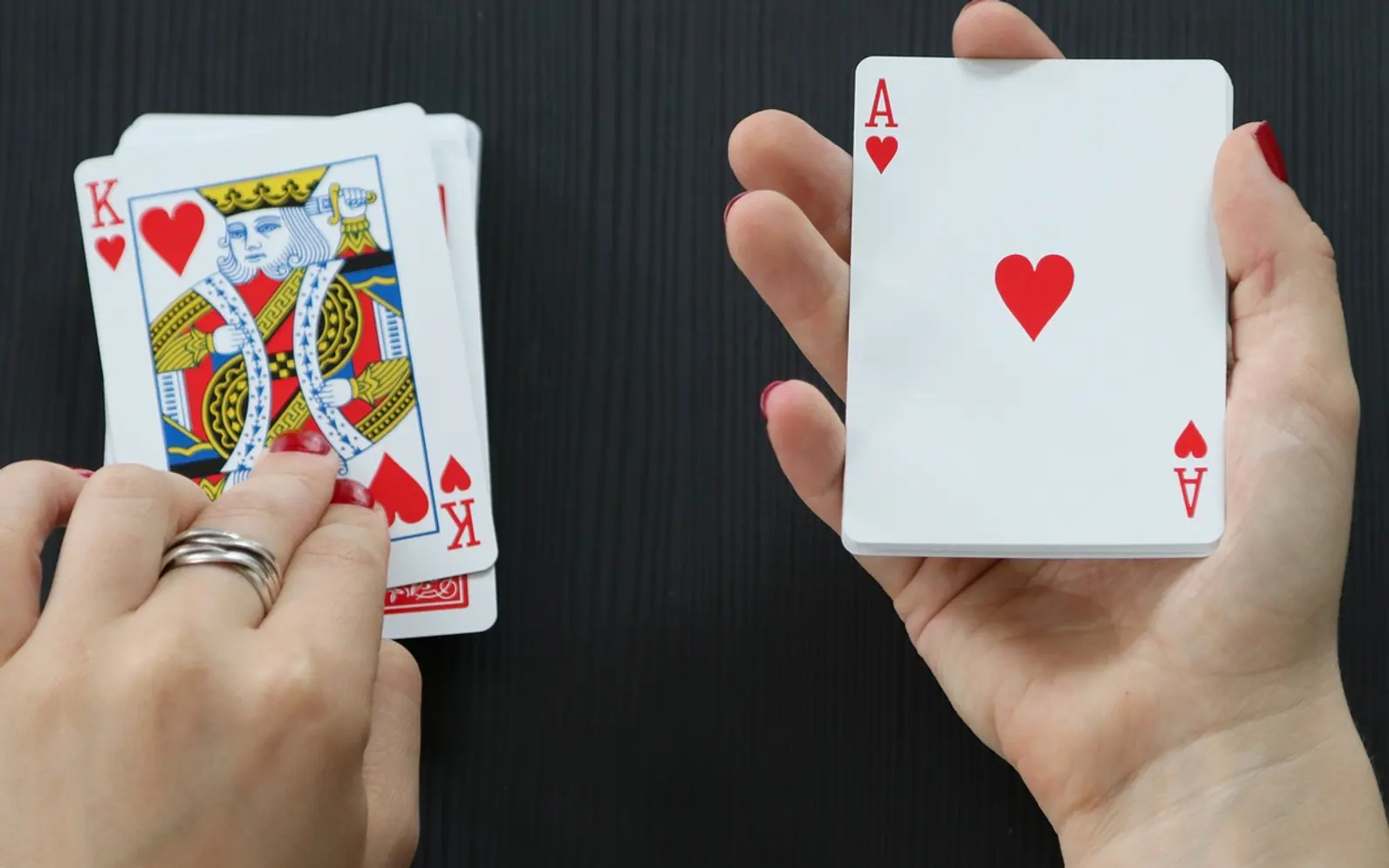
Blackjack insurance is a side bet offered when the dealer's face-up card is an ace. You may stake up to half of your original bet that the dealer's hidden card is worth ten, which would give the dealer a blackjack. If it is, insurance pays 2 to 1. Despite the reassuring name, it does not protect your hand; it is a separate wager on a single card, and with a normal deck it loses money over time.
How the offer works
- The dealer's upcard is an ace, and the dealer offers insurance to the table.
- Each player may place an insurance bet of up to half their main bet, usually on a line marked on the felt.
- The dealer checks the hidden card.
- If it is a ten, jack, queen or king, the dealer has blackjack. Insurance bets are paid at 2 to 1, and main bets lose unless a player also holds blackjack.
- If not, insurance bets are collected and play continues as normal.
The outcomes in plain numbers
Take a main bet of 10 units and a full insurance bet of 5:
| Dealer's hidden card | Main bet | Insurance | Net on the insurance decision |
|---|---|---|---|
| Ten-value card (dealer blackjack) | Loses 10 | Wins 10 | Breaks even overall |
| Anything else | Plays on as normal | Loses 5 | 5 down before the hand continues |
This is why insurance can feel like a safety net: when the dealer does have blackjack, you walk away level. The question is how often that happens compared with how often you simply lose the 5.
Why 2 to 1 is not enough
A bet that pays 2 to 1 breaks even only if it wins exactly one time in three. Anything less and it loses money over many hands. So the question is whether the dealer's hidden card is a ten-value card at least a third of the time.
A standard 52-card deck holds 16 ten-value cards: four each of tens, jacks, queens and kings. That is 16 out of 52, or roughly 30.8 percent. With the dealer's ace removed from the deck, it becomes 16 out of 51, still only about 31.4 percent. Both figures sit below the one-in-three needed. Multi-deck shoes follow the same proportion, so the conclusion does not change with more decks.
No secret about the dealer is involved. It is simple counting, and it is the reason that basic strategy charts say to decline insurance.
Even money is insurance under another name
When you hold a blackjack and the dealer shows an ace, many dealers ask whether you want even money. Accepting means you are paid 1 to 1 on the spot instead of waiting to see the dealer's card. On a table where blackjack pays 3 to 2, a 10-unit bet works out like this:
| Choice | Dealer has blackjack | Dealer does not |
|---|---|---|
| Take even money | +10 | +10 |
| Decline | 0 (push) | +15 |
The result of taking even money is identical to holding a blackjack and buying full insurance. Since the insurance part is the losing component, declining is the better choice over time, even though it occasionally means watching a strong hand end in a push.
Why players take it anyway
- The name. Insurance sounds responsible, as if refusing it were careless.
- A good hand to protect. Holding 20 against an ace makes the possibility of losing it feel heavier.
- Memorable losses. The time the dealer turned over a king sticks in the mind; the many times insurance quietly lost do not.
The exception you may hear about
Insurance can become worthwhile when the remaining cards in a shoe hold an unusually high share of tens. Players who track cards closely sometimes act on this. It requires careful counting through a shoe and has no practical use on tables that shuffle continuously or on online games that reshuffle after every hand.
Surrender: a different kind of exit
Surrender is sometimes confused with insurance, but it is a separate rule. Where it is offered, you may give up half your bet and end the hand immediately, usually after the dealer has checked for blackjack. Unlike insurance, surrender is part of basic strategy for a few specific weak hands against strong dealer cards. Tables vary in whether they allow it at all, so check the rules before relying on it.
The same habit of separating side bets from the main game applies to Pair Plus in Three Card Poker and to the bonus bet in Let It Ride: each has its own maths, and each adds to what is at stake on every hand.
Blackjack is for adults, and only in places where it may legally be played. Bring a set amount to the table, treat it as the cost of the evening, and stop once it is gone.
Don’t miss these
 Online GamblingThe Factors Driving the Popularity of Online Football Betting Platforms in Vietnam2 min
 Money HabitsNeeds vs Wants: Sorting Spending Into Two Honest Piles4 min
- Card TablesBlackjack Insurance: Why the Side Bet Rarely Adds Up4 min
 Card TablesLet It Ride Poker: Three Bets, Two Chances to Pull Back4 min